

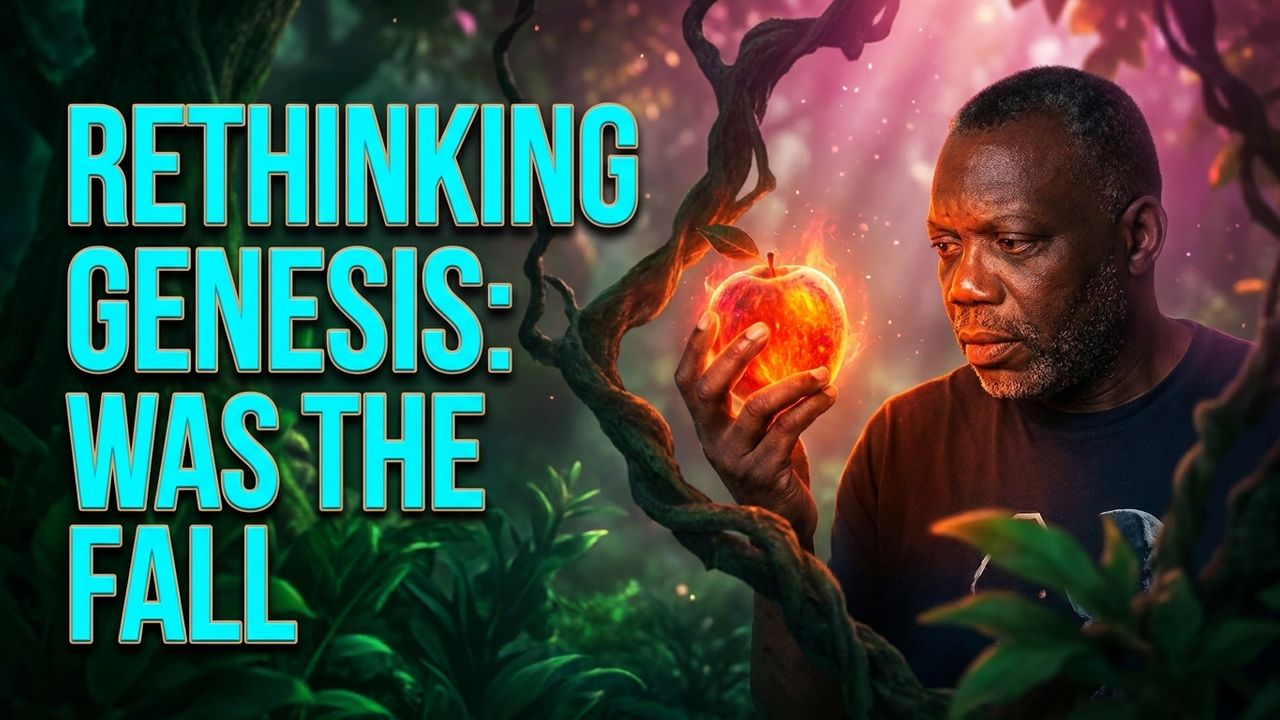
We have all heard the traditional story of the Garden of Eden: a beautiful paradise, a talking serpent, and a piece of forbidden fruit—often depicted as an apple—that brought about the fall of humanity. But what if the story we’ve been told for generations is only scratching the surface? What if the “fruit” wasn’t something you eat, but something far more complex and consequential?
In a thought-provoking deep dive into the Book of Genesis, we explore a radical re-examination of the fall of man. By looking closely at the original language, the timing of God’s commands, and the specific reactions of Adam and Eve, we can begin to uncover a narrative that involves spiritual warfare, legal covenants, and the loss of dominion. It is time to move past the Sunday school illustrations and look at the gritty, spiritual reality of what happened in the garden.
The Secondhand Prohibition: Eve’s Disadvantage
One of the most overlooked details in the Genesis narrative is the timing of God’s command. In the transcript, it is pointed out that when God gave Adam the prohibition regarding the Tree of Knowledge of Good and Evil, Eve had not even been created yet. This means that for Eve, the instruction was secondhand information. She didn’t hear it directly from the mouth of the Creator; she heard it from Adam.
This gap in direct communication created a point of vulnerability. When the serpent approached Eve, he didn’t just lie; he exploited a lack of firsthand experience. The serpent asked, “Has God indeed said, you shall not eat of every tree of the garden?” By questioning the word she received through Adam, the serpent began the process of “beguiling” her—a term that carries much more weight than simple trickery.
Decoding “Beguiled”: More Than a Simple Lie
The word “deceived” is often used to describe Eve’s interaction with the serpent, but the transcript argues that the more accurate term is beguiled. To truly understand what happened, we have to look at the Greek and Hebrew nuances of this concept. The speaker highlights several specific definitions of beguilement that change the context of the Fall:
-
Delazo: Used in James 1:14, this means to entice or to “catch with bait.” It is a fishing term, describing how a fisherman hides a hook inside something the fish finds desirable.
-
Exapatao: This refers to being thoroughly cheated or completely deceived into accepting a falsehood as the absolute truth.
-
Paralogizomai: This term refers to miscalculation or being imposed upon by “mere probability.” It suggests a sophisticated intellectual manipulation.
When we apply these definitions to the garden, we see a serpent that didn’t just offer a snack. He used his gifting, appearance, and spiritual ability to seduce and entice Eve. The goal wasn’t just to get her to break a rule; it was to bait a hook that would eventually catch all of humanity.
The Mystery of the “Opened Eyes”
A central question raised in this study is: Why were their eyes opened? If the sin was simply eating a piece of physical fruit, why was the immediate result a sudden, jarring awareness of nakedness?
The transcript challenges the idea that God punishes sin in a way that is disconnected from the crime. Usually, the consequence is commensurate with the act. If they ate an apple, why did they feel the need to cover their bodies? Why did the concept of “nakedness”—a concept they didn’t even have a framework for—suddenly become their primary source of shame?
The speaker suggests that the “fruit” was actually a sexual act of fornication or adultery. This interpretation argues that the serpent didn’t just talk Eve into a meal; he seduced her into a covenant-forming act. This would explain why the immediate reaction was physiological shame and a desperate attempt to cover their reproductive areas with fig leaves—an act the speaker describes as the first attempt at “self-righteousness.”
The Introduction of Sorcery and Witchcraft
This perspective suggests that the Fall was the introduction of sorcery and witchcraft into the human experience. By engaging in a forbidden act with a malevolent spiritual being, a new covenant was formed. In the spiritual realm, covenants are legal contracts. This act allowed the “marine kingdom” and other spiritual entities to gain a legal foothold, or dominion, over the planet and the human race.
Adam’s Choice and the Loss of Dominion
If Eve was the only one who had been beguiled, the speaker posits a controversial theory: Could God have simply replaced Eve? Since the original prohibition was given specifically to Adam, and Adam held the ultimate dominion over the earth, the fate of humanity rested on his shoulders.
Adam was not “beguiled” in the same way Eve was. He saw what had happened and made a conscious choice. When he called Eve “bone of my bone and flesh of my flesh,” he identified with her so deeply that he chose to join her in her fallen state rather than remain in his position of authority. The speaker even suggests that the act of intimacy that followed was a perversion of the original design, potentially marking a radical shift in how humans related to one another and to God.
When God asked, “Who told you that you were naked?” He wasn’t looking for information; He was pointing out that their entire perception of reality had been corrupted. They had moved from a state of spiritual light to a state of carnal awareness.
Key Takeaways from This Perspective
-
Direct Word vs. Secondhand Word: Eve’s lack of a direct command from God made her a target for the serpent’s subtle manipulations.
-
The Nature of Beguilement: The serpent used “bait” and seduction, not just a verbal lie, to lead Eve into transgression.
-
The “Fruit” as an Act: The immediate shame regarding nakedness suggests the “forbidden fruit” was a sexual or covenant-forming act rather than a physical piece of food.
-
Legal Dominion: The Fall was a legal transfer of power. By tricking humanity into a forbidden covenant, the serpent gained access to the earthly realm.
-
Adam’s Responsibility: As the primary holder of dominion, Adam’s decision to follow Eve into sin was the final seal on the fall of man.
Conclusion: Re-evaluating the Foundations
The story of Adam and Eve is often treated as a simple moral fable about obedience. However, when we dig into the linguistic roots and the spiritual implications of the text, it becomes a complex legal and spiritual drama. The idea that the Fall involved seduction, sorcery, and the formation of unholy covenants changes how we view spiritual warfare today.
If the foundations of our fallen state are rooted in these deep, covenantal deceptions, then our restoration must be equally deep. Understanding the true nature of the “beguilement” in the garden helps us appreciate the magnitude of what was lost—and the incredible power of the covenant required to get it back. As we continue to study these ancient texts, we must be willing to ask the hard questions: Is everything we think we know about the Bible actually what it says? Or have we been blinded by tradition to the deeper truths hidden in plain sight?
Deliverance Chronicles: https://deliverancechronicles.org YouTube: https://www.youtube.com/@DCGlobalnetworks Wayne T.Richards: https://www.waynetrichards.com The Covering: https://dcglobalnetworks.org/thecovering Authors Bio on Amazon: https://www.amazon.com/author/waynetrichards Repentance Prayer: https://deliverancechronicles.org/new-repentance-prayer/ Mentorship Program: https://app.paperbell.com/checkout/packages/160143 Amazon Authorship: ww.amazon.com/author/waynetrichards Unveiling the Marine Kingdom: Exposing Hidden Influences: https://a.co/d/a8ttXne “The Arsenal” Praying with the God of War!! Vol. 2: https://a.co/d/9YNnYZL Watch the full video: https://www.youtube.com/watch?v=O5-CJxO6uSc
About Author




 Deliverance Chronicles Global Networks
