

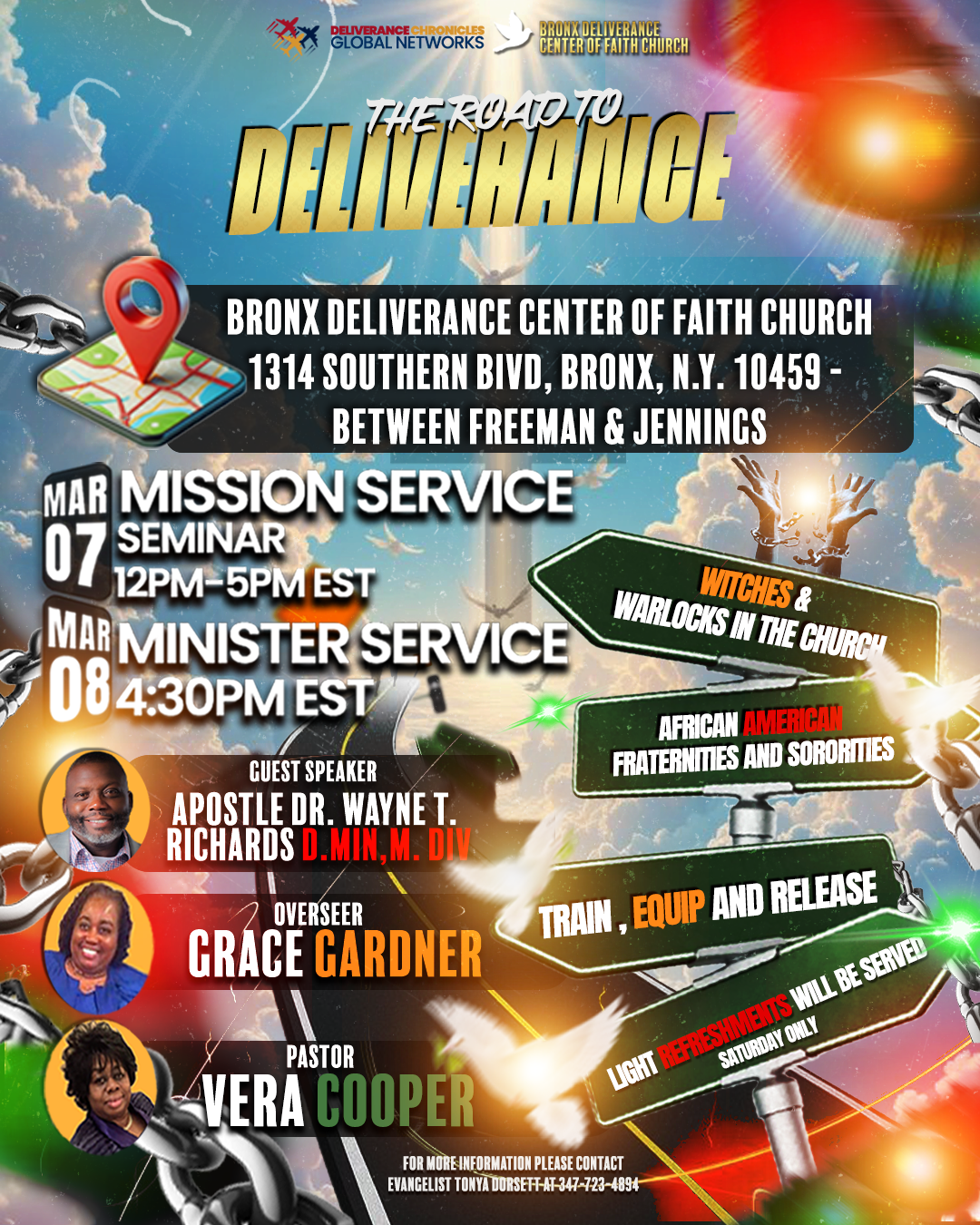
The Road to Deliverance
Witches and Warlocks in the Church
Day 1
Teaching on Witches and Warlocks in the Pulpit
Introduction:
Witchcraft and sorcery have been subjects of concern and caution throughout Scripture. In Christian teachings, it is essential to understand what witchcraft entails, its implications, and how it contrasts with the teachings of the Bible. This teaching will explore the definitions of witchcraft, provide scriptural references, and discuss the importance of spiritual discernment.
Witchcraft
In the biblical context, “witchcraft” refers to occult/sorcery practices—attempts to access supernatural power or guidance through means God forbids, rather than trusting and obeying Him.
What it includes (biblically)
– Sorcery / magic arts (trying to manipulate outcomes through spells/rituals)
– Divination (seeking hidden knowledge—omens, fortune-telling, etc.)
– Necromancy / consulting the dead or “familiar spirits”
– Enchantments and other occult practices tied to spiritual beings
Key passages that group these practices:
– Deuteronomy 18:10–12 (forbids divination, sorcery, witchcraft, mediums/necromancers)
– 1 Samuel 28 (Saul consults a medium at Endor)
– Galatians 5:19–21 (includes “witchcraft/sorcery” among “works of the flesh”)
– Revelation 21:8; 22:15 (condemns “sorcerers”)
Important nuance: translation
Many English Bibles use “witchcraft,” but the underlying terms often mean “sorcery” (Greek pharmakeia) and related occult practices. The focus is less “a woman with a broom” and more forbidden spiritual/occult power-seeking.
Bottom line
Biblically, “witchcraft” is seeking or using spiritual power/knowledge apart from God, typically through occult means, and it’s treated as rebellion against God’s authority (cf. 1 Samuel 15:23).
Witch
The Bible doesn’t give a single, formal “dictionary definition” of a witch or warlock. Instead, it uses several terms for people who practice forbidden occult arts—seeking supernatural knowledge or power apart from God.
“Witch” (common biblical idea)
A “witch” in biblical usage corresponds to a person who:
– practices sorcery/spells/omen (attempts to manipulate events through occult power), and/or
-consults spirits/the dead for guidance (mediumship/necromancy).
Main biblical terms behind “witch”
– Hebrew _kāshaph_ (verb: “practice sorcery”) and _mekhashshephah_(female practitioner).
Example: Exodus 22:18 (often translated “You shall not allow a sorceress/witch to live”).
– Hebrew terms for mediums/necromancers often associated with “witchcraft”:
_’ōv_ (“medium/familiar spirit”) and _yidde‘onî_ (“spiritist/medium”).
Example: Deuteronomy 18:10–12; 1 Samuel 28 (the medium at Endor).
What does scripture says about Witches or Witchcraft
Mediums / Necromancy
Leviticus 19:31 (KJV)
“Regard not them that have familiar spirits, neither seek after wizards, to be defiled by them: I am the LORD your God.”
NLT (ref + sense): Don’t defile yourselves by turning to mediums/spirits; the LORD is your God.
Leviticus 20:6 (KJV)
“And the soul that turneth after such as have familiar spirits, and after wizards, to go a whoring after them, I will even set my face against that soul, and will cut him off from among his people.”
NLT (ref + sense): If anyone consults mediums/spirits, God will turn against them and cut them off.
Leviticus 20:27 (KJV)
“A man also or woman that hath a familiar spirit, or that is a wizard, shall surely be put to death: they shall stone them with stones: their blood shall be upon them.”
NLT (ref + sense): Men or women who act as mediums/necromancers are to be executed.
Deuteronomy 18:11 (KJV)
“Or a charmer, or a consulter with familiar spirits, or a wizard, or a necromancer.”
NLT (ref + sense): Do not be found practicing spell-casting, consulting spirits, or calling up the dead.
1 Samuel 28:3 (KJV)
“Now Samuel was dead, and all Israel had lamented him, and buried him in Ramah, even in his own city. And Saul had put away those that had familiar spirits, and the wizards, out of the land.”
NLT (ref + sense): Samuel had died; Saul had earlier removed mediums and spiritists from the land.
1 Samuel 28:7–8 (KJV)
“Then said Saul unto his servants, Seek me a woman that hath a familiar spirit, that I may go to her, and enquire of her. And his servants said to him, Behold, there is a woman that hath a familiar spirit at Endor.
And Saul disguised himself, and put on other raiment, and he went, and two men with him, and they came to the woman by night: and he said, I pray thee, divine unto me by the familiar spirit, and bring me him up, whom I shall name unto thee.”
NLT (ref + sense): Saul secretly goes to a medium at Endor at night and asks her to bring up the dead.
2 Kings 21:6 (KJV)
“And he made his son pass through the fire, and observed times, and used enchantments, and dealt with familiar spirits and wizards: he wrought much wickedness in the sight of the LORD, to provoke him to anger.”
NLT (ref + sense): Manasseh practiced sorcery/omens, consulted mediums/spiritists; it was great evil before the LORD.
2 Kings 23:24 (KJV)
“Moreover the workers with familiar spirits, and the wizards, and the images, and the idols, and all the abominations that were spied in the land of Judah and in Jerusalem, did Josiah put away, that he might perform the words of the law which were written in the book that Hilkiah the priest found in the house of the LORD.”
NLT (ref + sense): Josiah eliminated mediums/spiritists and other abominations to obey the Law.
Isaiah 8:19–20 (KJV)
“And when they shall say unto you, Seek unto them that have familiar spirits, and unto wizards that peep, and that mutter: should not a people seek unto their God? for the living to the dead?
To the law and to the testimony: if they speak not according to this word, it is because there is no light in them.”
NLT (ref + sense):** Don’t consult mediums/whisperers; seek God and his instruction/testimony instead.
Divination / Omens
Deuteronomy 18:10 (KJV)
“There shall not be found among you any one that maketh his son or his daughter to pass through the fire, or that useth divination, or an observer of times, or an enchanter, or a witch,”
NLT (ref + sense): Do not practice fortune-telling/divination, interpret omens, or engage in occult practices.
Deuteronomy 18:14 (KJV)
“For these nations, which thou shalt possess, hearkened unto observers of times, and unto diviners: but as for thee, the LORD thy God hath not suffered thee so to do.”
NLT (ref + sense): Other nations listen to diviners/omen-readers, but the LORD forbids Israel to do so.
1 Samuel 15:23 (KJV)
“For rebellion is as the sin of witchcraft, and stubbornness is as iniquity and idolatry. Because thou hast rejected the word of the LORD, he hath also rejected thee from being king.”
NLT (ref + sense): Rebellion is like witchcraft; stubbornness like idolatry—Saul rejected the LORD’s word.
2 Kings 21:6 (KJV) (also listed above)
“And he made his son pass through the fire, and observed times, and used enchantments…”
NLT (ref + sense): Practiced divination/omens and sorcery; deeply evil.
Sorcery / Witchcraft
Exodus 22:18 (KJV)
“Thou shalt not suffer a witch to live.”
NLT (ref + sense): Do not allow a sorceress/witch to live.
Deuteronomy 18:10–12 (KJV)
“There shall not be found among you any one that maketh his son or his daughter to pass through the fire, or that useth divination, or an observer of times, or an enchanter, or a witch,
Or a charmer, or a consulter with familiar spirits, or a wizard, or a necromancer.
For all that do these things are an abomination unto the LORD: and because of these abominations the LORD thy God doth drive them out from before thee.”
NLT (ref + sense): The LORD detests these occult practices (divination, sorcery, spell-casting, consulting spirits, calling up the dead); they’re among the reasons nations were driven out.
Micah 5:12 (KJV)
“And I will cut off witchcrafts out of thine hand; and thou shalt have no more soothsayers:”
NLT (ref + sense): God will remove sorceries; there will be no more fortune-tellers.
Nahum 3:4 (KJV)
“Because of the multitude of the whoredoms of the well favored harlot, the mistress of witchcrafts, that selleth nations through her whoredoms, and families through her witchcrafts.”
NLT (ref + sense): Condemns Nineveh’s “witchcraft”/seductive practices by which she deceived nations.
Law/Commands passages (Torah: Exodus/Leviticus/Deuteronomy)
Exodus 22:18
“Thou shalt not suffer a witch to live.”
Leviticus 19:31
“Regard not them that have familiar spirits, neither seek after wizards, to be defiled by them: I am the LORD your God.”
Leviticus 20:6
“And the soul that turneth after such as have familiar spirits, and after wizards, to go a whoring after them, I will even set my face against that soul, and will cut him off from among his people.”
Leviticus 20:27
“A man also or woman that hath a familiar spirit, or that is a wizard, shall surely be put to death: they shall stone them with stones: their blood shall be upon them.”
Deuteronomy 18:10–12
“There shall not be found among you any one that maketh his son or his daughter to pass through the fire, or that useth divination, or an observer of times, or an enchanter, or a witch,
Or a charmer, or a consulter with familiar spirits, or a wizard, or a necromancer.
For all that do these things are an abomination unto the LORD: and because of these abominations the LORD thy God doth drive them out from before thee.”
Deuteronomy 18:14
“For these nations, which thou shalt possess, hearkened unto observers of times, and unto diviners: but as for thee, the LORD thy God hath not suffered thee so to do.”
1 Samuel 28:7–8
“Then said Saul unto his servants, Seek me a woman that hath a familiar spirit, that I may go to her, and enquire of her. And his servants said to him, Behold, there is a woman that hath a familiar spirit at Endor.
And Saul disguised himself, and put on other raiment, and he went, and two men with him, and they came to the woman by night: and he said, I pray thee, divine unto me by the familiar spirit, and bring me him up, whom I shall name unto thee.”
2 Kings 21:6
“And he made his son pass through the fire, and observed times, and used enchantments, and dealt with familiar spirits and wizards: he wrought much wickedness in the sight of the LORD, to provoke him to anger.”
2 Kings 23:24
“Moreover the workers with familiar spirits, and the wizards, and the images, and the idols, and all the abominations that were spied in the land of Judah and in Jerusalem, did Josiah put away, that he might perform the words of the law which were written in the book that Hilkiah the priest found in the house of the LORD.”
Isaiah 8:19–20
“And when they shall say unto you, Seek unto them that have familiar spirits, and unto wizards that peep, and that mutter: should not a people seek unto their God? for the living to the dead?
To the law and to the testimony: if they speak not according to this word, it is because there is no light in them.”
Micah 5:12
“And I will cut off witchcrafts out of thine hand; and thou shalt have no more soothsayers:”
Nahum 3:4
“Because of the multitude of the whoredoms of the wellfavoured harlot, the mistress of witchcrafts, that selleth nations through her whoredoms, and families through her witchcrafts.”
Witches and Warlock’s in the Pulpit
– A “Witch” in the pulpit
– Claims to be a pastor/prophetess while openly practicing spell-work, hexes, curses, or “root work.”
– Leads the congregation in rituals (candles, crystals, incantations) presented as “anointed tools” for power or protection.
– Encourages people to seek tarot, astrology, horoscopes, palm reading, spirit guides, or “energy readings” as spiritual direction.
– Frames the Holy Spirit as an impersonal force/energy that can be manipulated through techniques rather than obeyed as God.
– Teaches “manifesting” as speaking things into existence apart from God’s will—treating words like magic formulas.
– Uses “prophecy” to control: threatening spiritual harm, “bad luck,” or curses if members leave or disagree.
– Mixes Bible verses with **occult systems (e.g., conjure practices, channeling, contacting the dead) and calls it “kingdom.”
– Promotes Syncretism: blending Jesus with other spirits/deities and saying it’s all the same God.
– A “Warlock” in the pulpit
– Claims to be a minister while teaching or practicing sorcery/occult power for domination, revenge, or influence.
– Uses the pulpit to recruit people into secret oaths, covenants, or “inner circles” that promise power, protection, or prosperity.
– Performs “deliverance” that is actually occult theater—using objects, chants, or rituals to manipulate fear and loyalty.
– Teaches believers to invoke angels/demons or “territorial spirits” through formulas rather than prayer in Christ.
– Uses “prophetic words” as coercion: “God said you must give,” “God said you must marry,” “God said you can’t leave.”
– Claims “spiritual authority” that functions like spiritual intimidation—threats of sickness, death, or misfortune for disobedience.
– Sells “anointed” items as power objects (oils, cloths, rings) with promises that resemble talismans.
– Encourages contact with the dead (“ancestral guidance”) or “channeling” while calling it biblical revelation.
Note: Sometimes people use “witch/warlock” loosely to mean “manipulative” or “false teacher.” If you mean that broader (non-occult) sense—e.g., leaders who control, exploit, or twist Scripture—tell me and I’ll list examples for that category too.
The D9/NPHC Black Sororities
Alpha Kappa Alpha Sorority, Inc. (AKA)
Founded January 15, 1908, at Howard University (Washington, D.C.).
Founders: commonly credited to Ethel Hedgeman Lyle (lead organizer) and a founding group of students; the sorority later formalized leadership under additional early officers.
Public purpose: service, sisterhood, leadership, and community uplift.
Public symbols/colors:pink and green, ivy leaf; motto widely known as Service to All Mankind.”
Delta Sigma Theta Sorority, Inc. (DST)
Founded on January 13, 1913, at Howard University.
Founders:22 collegiate women (often referenced collectively as the “22 Founders”).
Public purpose: public service with emphasis on education, health, political awareness, and community programs.
Public symbols/colors: crimson and cream; recognized for early public activism (e.g., participation in the 1913 Women’s Suffrage March).
Zeta Phi Beta Sorority, Inc. (ZΦΒ)
Founded on January 16, 1920, at Howard University.
**Founders: Arizona Cleaver Stemons, Pearl Anna Neal, Myrtle Tyler Faithful, Fannie Pettie Watts.
Public purpose: scholarship, service, sisterhood, and finer womanhood.
Public symbols/colors: royal blue and white; the dove is commonly associated publicly.
Sigma Gamma Rho Sorority, Inc. (SGRho)
Founded on November 12, 1922, at Butler University (Indianapolis, Indiana).
Founders: seven educators (often referenced collectively as the “Seven Founders”).
Public purpose: community service, leadership development, education, and advocacy.
Public symbols/colors: royal blue and gold; focus historically tied to education and youth development.
About “Greek deities” and “pledging.”
– D9 organizations are Greek-letter organizations, meaning they use Greek letters and sometimes draw on Greek/classical imagery the way many U.S. fraternities/sororities do. That does not mean they “serve” or “worship” Greek deities.
– Membership requirements and initiation elements are private and vary by era and chapter; reputable summaries stick to publicly stated values, programs, and mottos, not internal rites.
Public mottos/statements
(These are public-facing and commonly quoted; wording can vary by official publication/era.)
– AKA: “Service to All Mankind.”
– Zeta Phi Beta: “A community-conscious, action-oriented organization.”
– DST / SGRho: have widely repeated public themes and slogans, but exact “affirmations” used in member-only settings are not something I can provide.
Idolatry is a significant theme in the Bible, addressing the worship of idols or false gods and emphasizing the importance of worshipping the one true God. Below are several key scriptures that address idolatry from both the Old and New Testaments:
Day 2
“Deliverance”
Introduction
– Defining Deliverance: Begin by explaining what deliverance means in a biblical context. Deliverance refers to the act of being set free from bondage, oppression, or spiritual strongholds.
– The Importance of Deliverance: Highlight the biblical basis for deliverance, emphasizing that it is a key component of Jesus’ ministry (Luke 4:18-19).
I. Understanding Bondage
– Types of Bondage: Discuss various forms of bondage that people may experience:
– Spiritual Bondage: Oppression by demonic forces.
– Emotional Bondage: Issues such as fear, anxiety, and depression.
– Physical Bondage: Addictions or unhealthy habits.
– Biblical Examples: Reference biblical figures who experienced bondage, such as the demoniac in Mark 5 or the Israelites in Egypt.
II. The Need for Deliverance
– Recognizing the Need: Encourage individuals to self-examine and identify areas in their lives where they feel stuck, oppressed, or unable to move forward.
– Spiritual Warfare: Discuss the reality of spiritual warfare (Ephesians 6:10-12) and the importance of being aware of the enemy’s tactics.
III. The Process of Deliverance
– Prayer and Fasting: Emphasize the power of prayer and fasting as tools for seeking deliverance (Matthew 17:21).
– Confession and Repentance: Teach about the importance of confessing sins and repenting as a means to break free from bondage (1 John 1:9).
– The Role of Community: Highlight the importance of support from fellow believers. James 5:16 encourages confessing sins to one another and praying for one another.
IV. The Authority of Jesus
– Jesus’ Power Over Darkness*: Explain how Jesus has authority over all spiritual forces and how believers can invoke His name in deliverance (Philippians 2:9-11).
– **The Role of the Holy Spirit**: Discuss how the Holy Spirit empowers believers for deliverance and guides them in their journey (Acts 1:8).
V. Walking in Freedom
– Living in the Light: Teach about the importance of walking in the light of God’s Word to maintain freedom (John 8:31-32).
– Establishing New Patterns: Encourage the congregation to build new habits and patterns that support spiritual health and freedom, such as prayer, worship, and fellowship.
– Continuing the Journey: Emphasize that deliverance is often a process and that ongoing growth and healing are part of the Christian journey.
VI. Sharing the Testimony
– The Power of Testimony**: Encourage individuals who have experienced deliverance to share their testimonies, which can bless others and bring hope (Revelation 12:11).
– Helping Others: Teach that those who have been delivered are often called to help others find freedom as well (2 Corinthians 1:3-4).
Conclusion
– Invitation for Prayer: Conclude with an invitation for those who feel they need deliverance to come forward for prayer. Encourage a spirit of openness and support within the community.
– Final Encouragement: Remind everyone that deliverance is part of the abundant life that Jesus offers (John 10:10) and that God desires for His people to walk in freedom and victory.
Final Thoughts
This teaching can be tailored to fit the specific context and needs of your audience. By focusing on the biblical principles of deliverance, you can encourage individuals to seek the freedom that Christ offers and to support one another in their journeys.
About Author


 Deliverance Chronicles Global Networks
